Art Marketing tips from Xanadu Gallery owner Jason Horejs
Published: Tue, 01/26/10
 | ||||||||||||||
|
Have you ever stood in an art gallery and said to yourself:
"My
work is better than the art in this gallery. Why are these artists
selling in galleries and I'm not?" Having owned a gallery for 8 years, I have spent the last several years helping artists answer this question. I have discovered it is the little things that can make all the difference in an artist's career. In August my book "Starving" to Successful | The Artist's Guide to Getting into Galleries and Selling More Art was published. The book gives you exact steps you can take to professionally approach galleries. Among the many recommendations I make in the book are the suggestions below. These are little things you can do to increase your effectiveness. Can little things make a difference in your career? I invite you to ponder the suggestions below, all ideas I expand upon in "Starving" to Successful. These little ideas, put into practice with your marketing plan will help you present your work more professionally. They will help you get into galleries and sell more of your art. Quality Check. I have known and worked with hundreds of artists over the years. The most successful artists are devoted to high quality. They have the ability to step back from their work and look at it through their buyer's eyes. Art collectors are picky. They demand attention to detail. Their homes are immaculate. You must create work that will fit seamlessly into their homes. Your medium doesn't matter - sculpture, jewelry, paintings, photography or fiber art - the presentation must be flawless. Think of each work you create as a masterpiece. Treat it as such. One small thing to improve the quality of your work: Invite someone you trust to evaluate the quality of your art. You should invite an artist you admire, or a designer, or a gallery owner over to the studio for coffee. Present 5-6 pieces. Ask the question "what are three things I could do to improve the quality of my presentation." An objective observer will see your art in a way you never could. Repeat this process every 1-2 years and make a commitment to constantly improve your quality. Read a Book. Collectors and dealers love to talk history. As you begin to show in galleries and interact with collectors at shows you will find they love to talk about past masters. Your relationships with collectors and dealers will deepen if you can converse fluently about art history. I suggest you strive to understand the major art movements from the impressionists through the present day. This understanding will also enrich your work as you are inspired by the great artist's lives and works. One little thing to work on: Visit your local book store or Amazon.com and order a biography of one of your favorite artists. Commit to read 2 artist biographies per year. Don't limit your reading only to artists you like. I wasn't a fan of Willem deKooning's work until I read about his life. He is now one of my favorite artists. Analyze your Competition. You don't have to reinvent the wheel when it comes to marketing your work. With a little work, you will find hundreds of artists whose work is comparable to yours. Learn from them. Do what they do. One little thing to work on: Every week, devote one hour to researching your competition online. Type keywords describing your work into a search engine and you will quickly encounter your competitors. Develop a list of 10 artists you feel are closest to you in style, genre, subject, and/or experience. Analyze them. Ask: Where is the artist from? What is his/her background? What is his/her education? What does the artist's résumé look like? What about his/her bio and artist's statement? What galleries is he/she showing in? How does he/she advertise his/her work? How is his/her work priced? How is he/she presenting his/her work? The insight you will gain through this weekly exercise will prove invaluable to you as you develop your marketing plans. By understanding your competition you can better tailor your work to the market. You can price your work competitively. You can better understand the types of galleries you should approach. Use an Inventory Number. As you begin to experience success, organizing your inventory becomes critical. Using an inventory number is an easy way to start to control your inventory. As you move artwork from the studio to your galleries, and from gallery to gallery and inventory number will make it easy to track your work. Titles can get mixed up, but inventory numbers are almost infallible. If you don't already have an inventory numbering system, start with a high number (3000, for example). Nothing says "new artist" like a low inventory number. Send a Thank-you note. As you begin to work with collectors and galleries, your goal is not to sell art. Your end-goal is to create relationships. Relationships will lead to a lifetime of sales. You will be amazed what one simple thing like a hand-written thank-you note can do for your relationships. In this age of digital communication and voicemail interaction, a hand-written thank you note stands out. When a gallery sends you a commission check you should immediately sit down and write a thank-you note. Keep the note simple: Dear Tim, Thank you for your check for the sale of "Evening Tide". I appreciate everything you and your staff do to promote my work. Please let me know of any way I may be of service. Best regards, Jane Spend Some Time on Marketing. I am amazed at how many artists will spend long days in the studio, weeks in workshops, but then wonder why their work isn't selling. Often, these same artists are devoting very little time to marketing. You should be spending 10% of your time marketing. You will be amazed by how much you can accomplish in this small amount of time, and this is one small thing that will make a huge difference in your career. If you haven't already done so, I invite you to order my book and learn how to succeed in the art business The book will give you concrete, actionable guidance in organizing the business side of your career. I will also give you an understanding of the art business from the perspective of a gallery owner with 17+ years experience in the business. 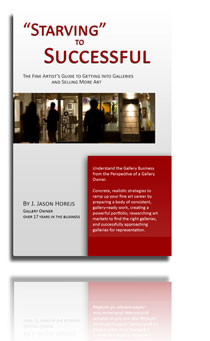 If I can give you one idea that helps
you sell one work of art would it be worth $25? I am going to give many
more ideas than just one. If you are
ready to put your art career on track and start selling your work, I
invite you to order the book now at www.xanadugallery.com.
If I can give you one idea that helps
you sell one work of art would it be worth $25? I am going to give many
more ideas than just one. If you are
ready to put your art career on track and start selling your work, I
invite you to order the book now at www.xanadugallery.com.I have extended the pre-publication price to you, even though the book is now in its second printing. I have heard from many artists who intended to order but missed the pre-publication offer. You may order the book today at $19.50, $5.45 off the cover price. This is a limited offer, so order at your earliest convenience.  Sincerely,  J. Jason Horejs Owner Xanadu Gallery 7039. E. Main St. #101 Scottsdale, AZ 85251  www.xanadugallery.com jason@xanadugallery.com P.S. If you are unsatisfied with the book for any reason, you may return it for a full refund with no questions asked. Testimonial from artists who have recently read the book.
| ||||||||||||||
Advertise your Art Contest, Competition or Art Opportunity to over 14,700+ artists
and photographers on TheArtList.com For More Information: http://www.theartlist.com
** You are receiving this email advertisement because you have previously "opted-in" to TheArtList.com mailing list.
If this art call or announcement is not of interest to you, simply delete the email. If you no longer wish to receive any art call
announcements, newsletters, or information from TheArtList.com, please use the "Unsubscribe" link. **